TRADINGVIEW → NINJATRADER
How TradingView to NinjaTrader automation works
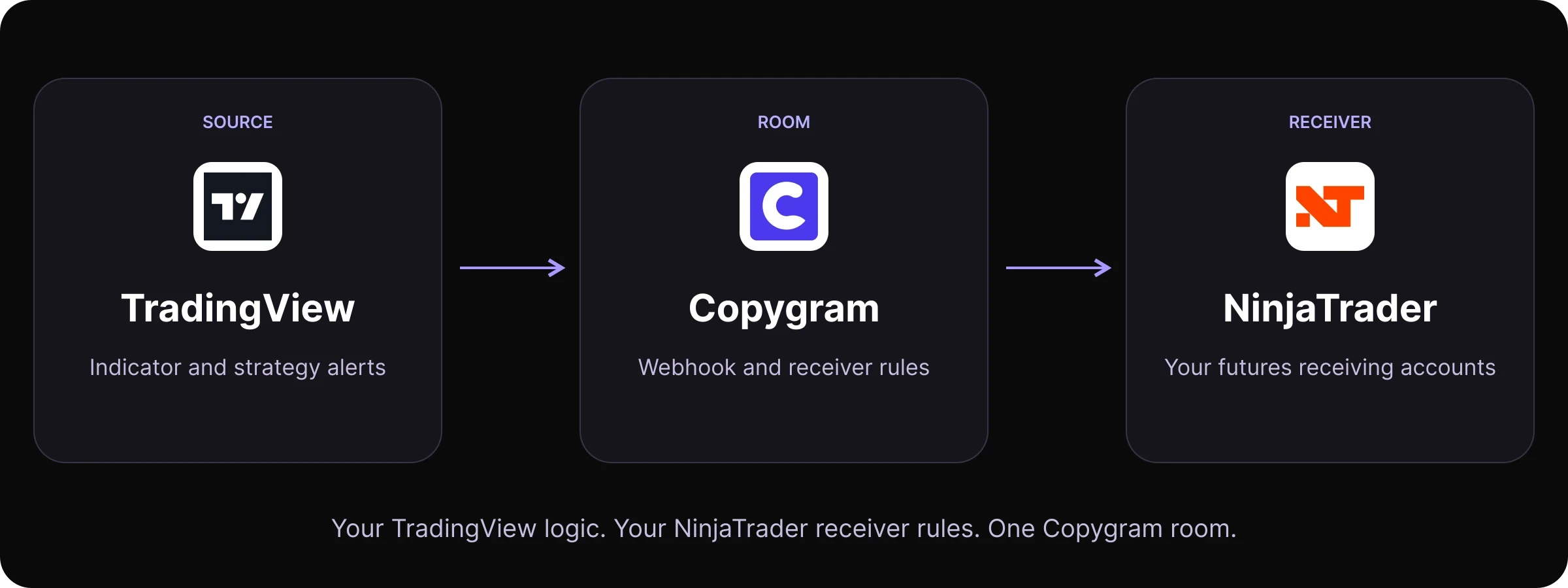
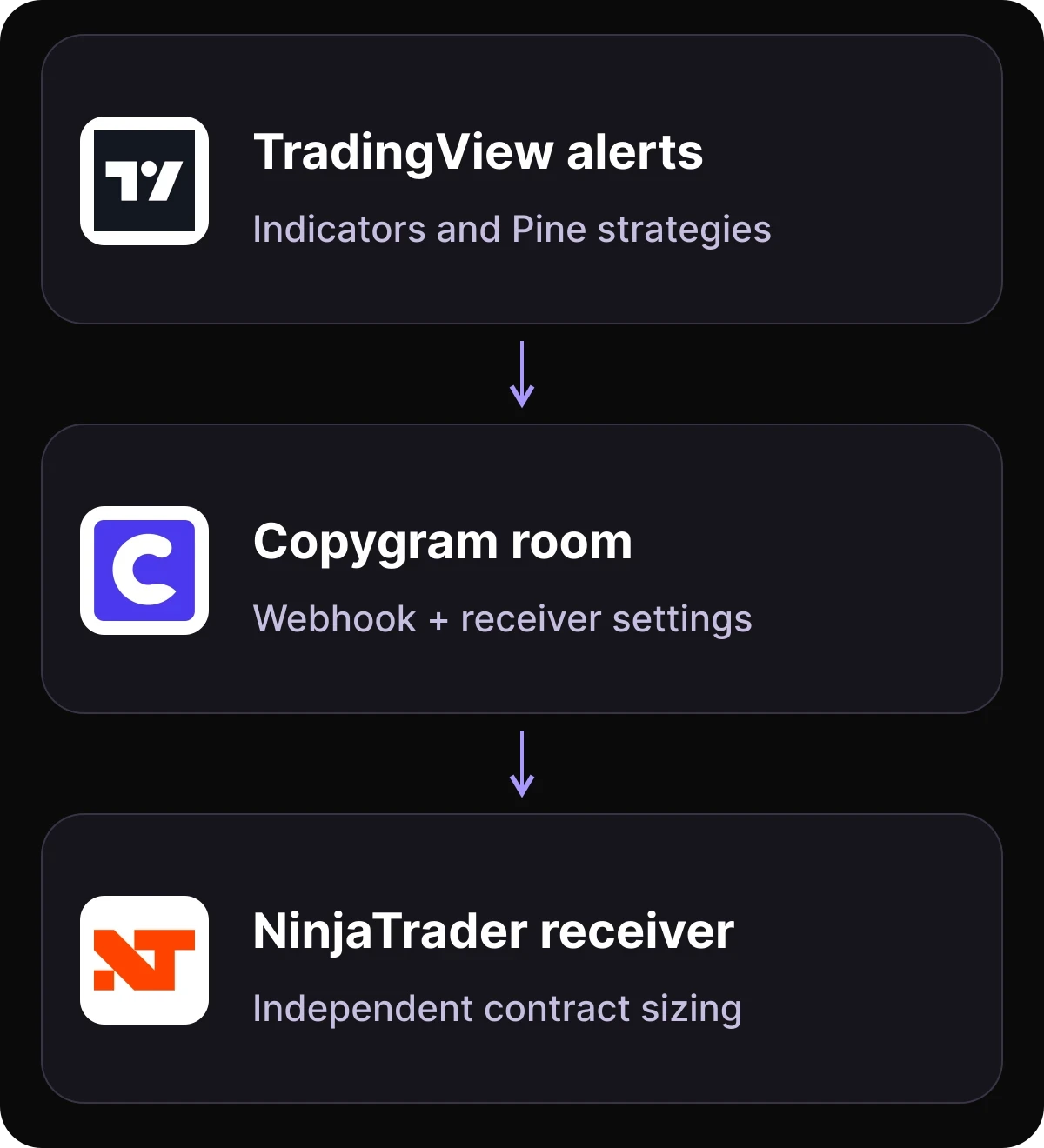
A TradingView to NinjaTrader trade copier receives an alert message and turns its instructions into an order for a connected NinjaTrader account. Copygram links your TradingView webhook source to one or more receivers in a room, with separate settings for each account.
TradingView sends the alert
Your indicator or Pine Script strategy supplies the opening or trade-management instruction. Configure its event, message and webhook notification.
Copygram applies your rules
The webhook source feeds your room. Copygram parses JSON or plain text and applies each receiver’s instruments, quantities and trade-management settings.
NinjaTrader receives the order
The selected futures account receives the instruction with its own contract and quantity. Follow its orders and positions alongside Copygram’s signal log.
QUICK START
Connect TradingView to NinjaTrader in five steps
Connect the receiving account, create your webhook, choose the alert and configure your futures rules.
Add a trading account in Copygram and select NinjaTrader. Enter your NinjaTrader username and password; the Device ID is generated automatically. Choose the receiving account and demo or live environment. The connection uses the official Tradovate API.

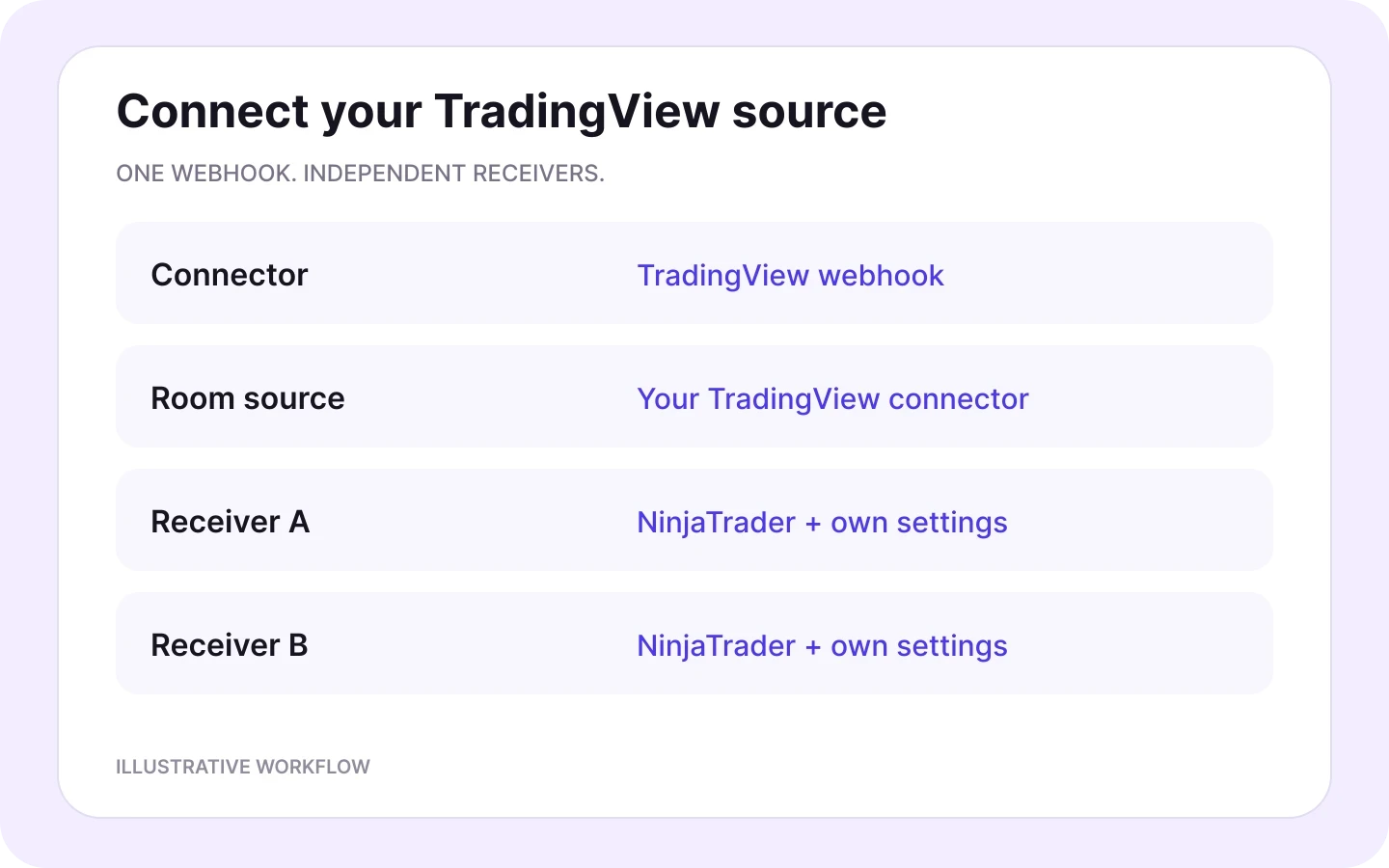
Open Connectors → TradingView in Copygram and create your webhook URL. Select that connector as the source of a room and add NinjaTrader as a receiver. Add more receiving accounts within your plan’s allowance, with independent settings for each.
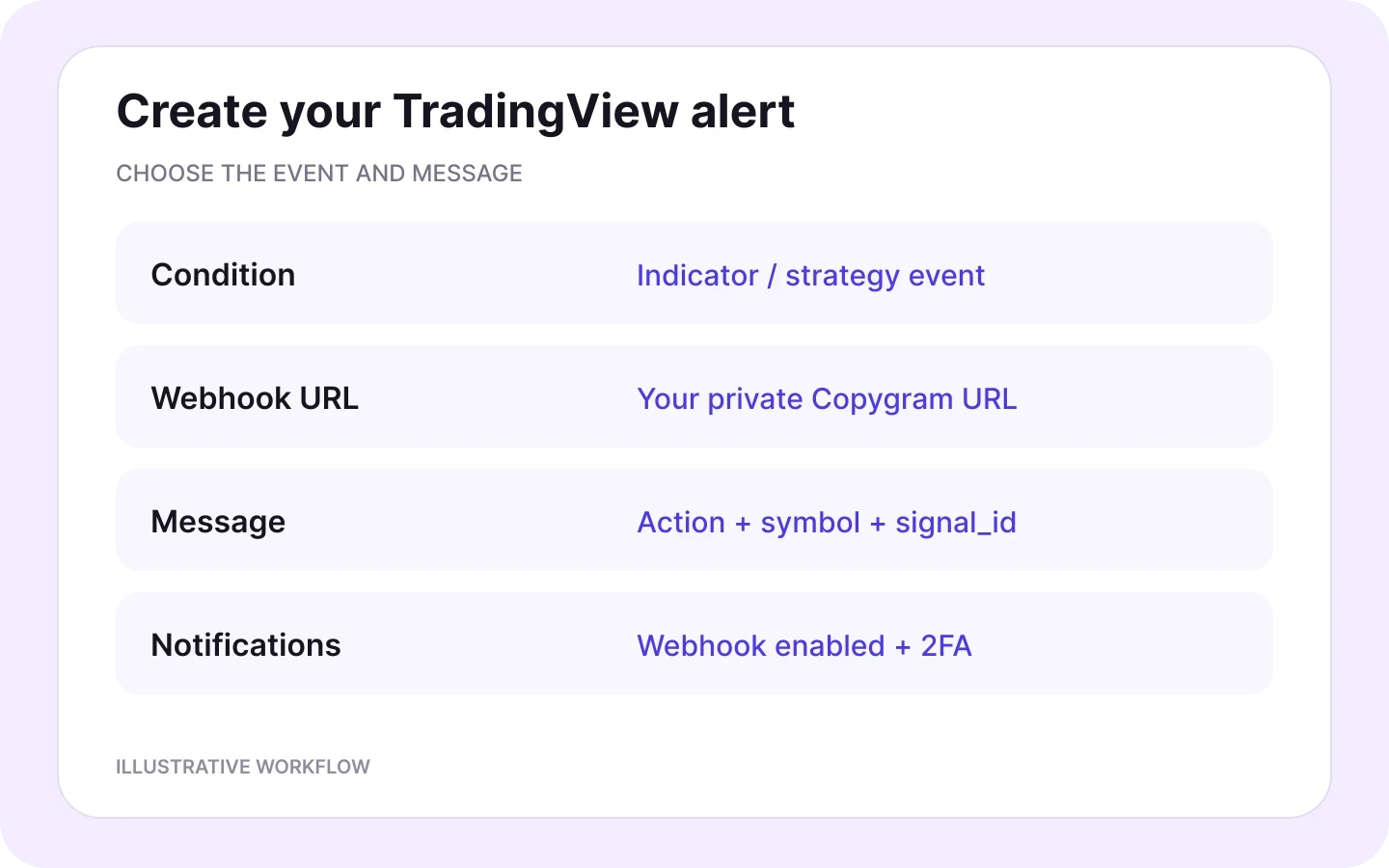
Select your indicator condition, strategy order-fill event or alert() calls. Put your Copygram URL in the Webhook URL field and add a clear trade message. Use a TradingView plan with webhook notifications and enable two-factor authentication.
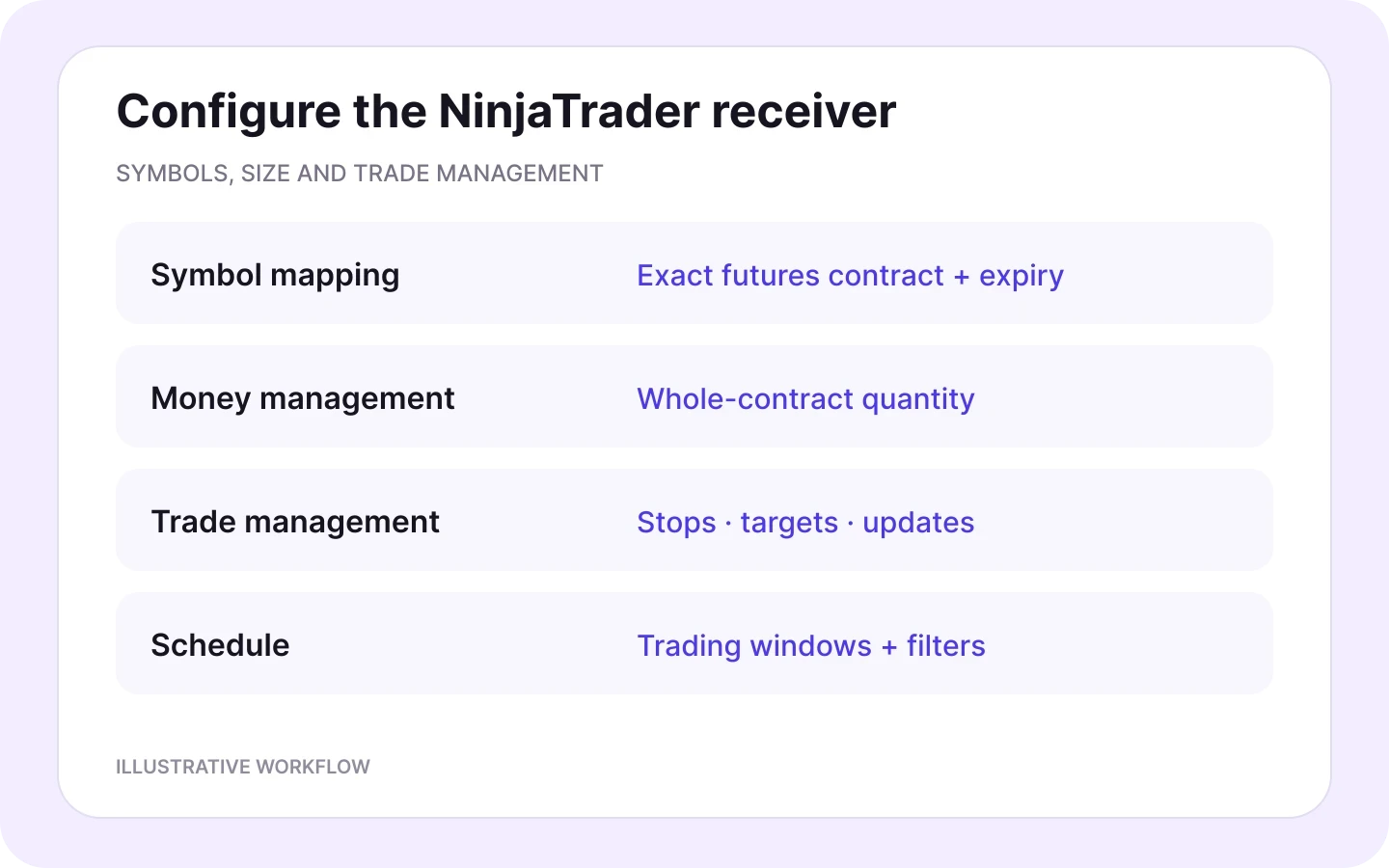
Map the incoming symbol to the exact NinjaTrader contract and expiry. Set whole-contract quantities, stop-loss and take-profit behavior, Copy Close Orders, Copy Modif Orders, filters and trading schedules.
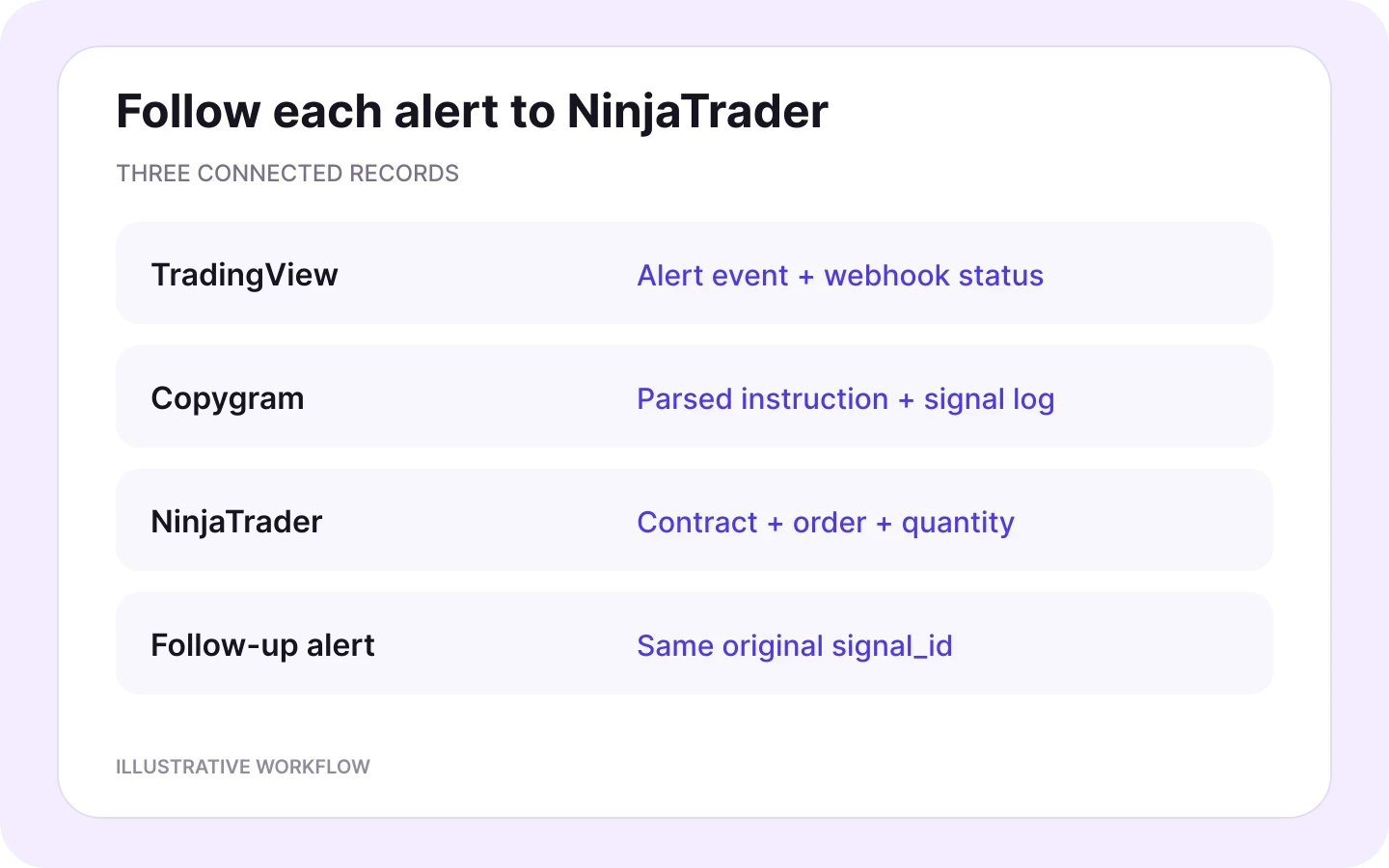
Activate your room to start automation. Follow TradingView’s alert and webhook status, Copygram’s parsed instruction and signal log, and the NinjaTrader account’s orders and positions. Use the original signal_id for later updates to the same trade.
INDICATORS & PINE SCRIPT
Automate indicator alerts and Pine Script strategy events
Choose the event that expresses the instruction your NinjaTrader receiver should follow. Keep opening and trade-management messages clear.
Indicator alert conditions
Select the condition supplied by your indicator, or its alert() messages. Create the running alert in TradingView and enable webhook delivery for your chosen event.
Strategy order-fill events
TradingView’s broker emulator generates strategy order-fill events. For custom strategy messages, use {{strategy.order.alert_message}} in the alert’s Message field.
Dynamic alert() messages
Use Pine Script alert() calls for dynamic instructions and your chosen timing. Select the event source deliberately so each intended action sends one instruction.
TradingView saves the script, inputs, symbol and timeframe when you create an alert. Recreate the running alert after relevant strategy or chart changes so the active instructions stay aligned with your strategy.
ALERT MESSAGES
Give every trade a clear instruction and identity
Send JSON or plain text. Use signal_id to connect an opening message to later updates and a targeted close.
Generate a new signal_id for each opening trade. Reuse the same value in its later modify or close messages. Include an explicit action and symbol, with entry, sl or tp when your instruction uses those prices. Configure the receiving contract quantity in Copygram.

Opening alert
Later targeted close
Illustrative message structures: map MNQ_SIGNAL to your selected futures contract and expiry, then set whole-contract quantity and protective settings. Generate a new ID for each new trade. Use an explicit close action for a targeted exit. Read Copygram’s message guide →
FUTURES CONTRACT MAPPING
Map the TradingView symbol to the right NinjaTrader contract
Match the symbol in the outgoing alert to the exact instrument and expiry on your receiving account.
Dated futures symbols
Use the intended market and expiry with the exact identifier available on your NinjaTrader receiver. Keep the alert symbol and receiver mapping easy to recognize.
Continuous charts and aliases
For NQ1!, ES1! or an alias such as MNQ_SIGNAL, map the incoming name to your selected dated contract. Review and update the mapping around futures rollover.
Prices and whole-contract size
Set receiver quantity separately from symbol mapping. Use the destination instrument’s price convention and tick size for stop-loss and take-profit levels.
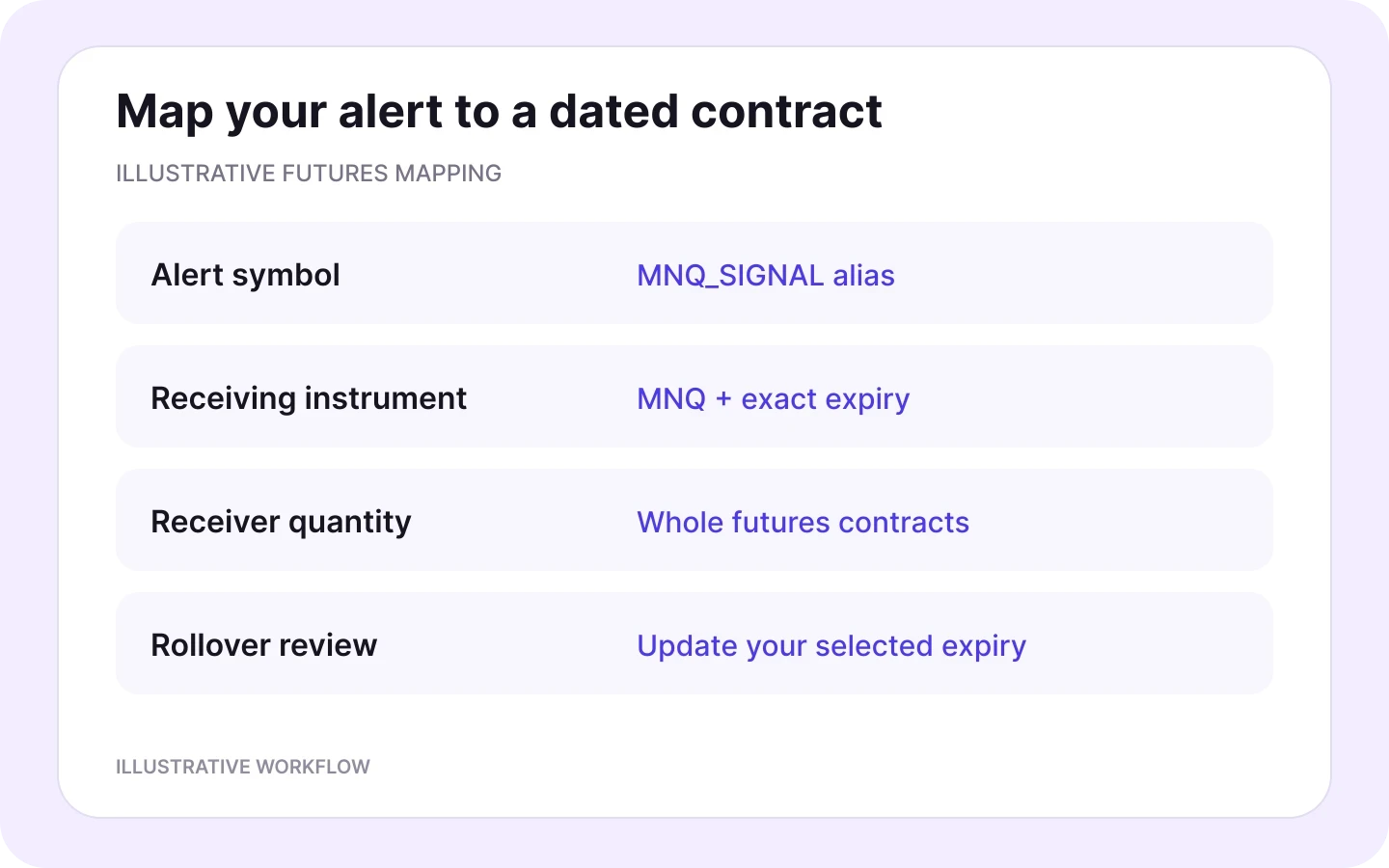
A continuous chart joins contracts over time. Keep the receiver’s dated contract and expiry aligned with your intended market. The MNQ_SIGNAL diagram is an illustrative alias mapping; your receiver settings determine its futures quantity and protective prices.
MULTIPLE ACCOUNTS. YOUR QUANTITIES.
Set futures contract quantity for every NinjaTrader receiver
Send one TradingView source to multiple accounts. Configure each receiver’s instrument, whole-contract quantity and trade-management rules independently.
Illustrative NinjaTrader receiver A
1 futures contract
The room uses Receiver A’s selected instrument and quantity. Its stops, targets, filters and schedule belong to that account.
Illustrative NinjaTrader receiver B
2 futures contracts
The same TradingView alert can feed Receiver B with its own quantity and trade-management settings. Add receiving accounts within your plan’s account allowance.
These quantities illustrate independent receiver settings, not a recommended position size. Futures use whole contracts. Apply Symbol Lot Exceptions for instrument-specific sizing ahead of the general money-management rule, and plan partial exits in whole contracts.
RECEIVER CONTROLS
Control how NinjaTrader receives your TradingView alerts
Give each receiving account its own instruments, quantities and trade-management settings.
Independent quantities
Set the NinjaTrader account’s whole-contract quantity for your selected instrument.
Symbol exceptions
Apply instrument-specific sizing rules ahead of the general money-management setting.
Mapping & filters
Map exact futures contracts and choose the symbols the receiver follows.
Stops & targets
Configure protective levels and the behavior for signals with or without those levels.
Copy Close Orders
Enable the closing actions you want the receiver to follow. Reuse the original signal_id for a targeted close.
Copy Modif Orders
Configure trade updates and reuse the original signal_id for later stop-loss or take-profit changes.
Trading schedules
Choose the days, trading windows and time zone for your futures market session.
Multiple targets
Configure webhook take-profit allocations using valid whole-contract closing quantities.
ALERT-TO-ORDER VISIBILITY
Follow every alert from TradingView to NinjaTrader
Connect the alert event, parsed instruction and receiving order through three clear records.
TradingView alert log
View the running alert, event time and Webhook status for the message sent to Copygram.
Copygram signal log
Follow the parsed action, symbol, signal_id and receiver status in your room’s activity.
NinjaTrader orders
View the actual contract, direction, whole-contract quantity, orders and positions in the selected account.
Use a clearly named room for each TradingView source and keep each receiver’s settings organized. TradingView runs active alerts on its servers, while Copygram receives the webhook through its cloud workflow.


SUPPORTED PLATFORMS
Connect TradingView to Every Major Platform
Explore destinations for your TradingView alerts, each with its own account connection, instruments and receiver settings.
NinjaTrader Trade Copier
Explore NinjaTrader as a source and receiver, with independent futures contract quantities and trade-management rules.
NinjaTrader hub

TradingView to Tradovate
Route indicator and strategy alerts to Tradovate with exact futures mapping and independent receiver quantities.
TradingView to Tradovate


TradingView to MetaTrader
Send TradingView webhook alerts to MT4 and MT5 accounts with receiver-specific symbols, lot sizes and trade-management rules.
TradingView to MetaTrader

TradingView to TradeLocker
Configure TradeLocker receivers for TradingView alerts with your own mapping, position sizing and protective settings.
TradingView to TradeLocker

TradingView to OANDA
Automate TradingView alerts on OANDA Live and Practice accounts with independent instruments and receiver quantities.
TradingView to OANDA

TradingView to Binance Futures
Send TradingView signals to Binance Futures with exact symbol mapping and independent receiver quantities and leverage.
TradingView to Binance Futures

TradingView to MatchTrader
Connect indicator and strategy alerts to MatchTrader demo and live accounts with independent receiver rules.
TradingView to MatchTrader

TradingView to DXtrade
Send TradingView webhook instructions to DXtrade using your broker domain, account and receiver settings.
TradingView to DXtrade
Explore all TradingView integrations
TradingView Hub
FAQ
TradingView to NinjaTrader FAQs
Answers about indicator and strategy alerts, webhook messages, futures contracts and receiver settings.
Can I automate TradingView alerts on NinjaTrader with Copygram?
Yes. Copygram connects TradingView webhook alerts to NinjaTrader receivers. Create a TradingView connector, select it as the source of a room and add NinjaTrader as a receiver. Configure the futures instruments, whole-contract quantities and trade-management settings, then activate the room.
Can I use TradingView indicator alerts?
Yes. Select an alert condition supplied by your indicator, or its alert() messages. Create the alert in TradingView, enter a clear trade instruction and add your Copygram webhook URL. Your chosen condition supplies the event that starts the automation.
Can I automate a Pine Script strategy on NinjaTrader?
Yes. Use your strategy’s TradingView alerts as the Copygram source. Choose strategy order-fill events or alert() calls and provide clear opening and management messages. Your strategy runs on TradingView, and Copygram routes its instructions to NinjaTrader using each receiver’s settings.
Do I need a TradingView plan with webhooks?
Yes. Your TradingView account needs webhook notifications, and two-factor authentication must be enabled. Choose a plan with the alert capacity your strategy uses. Your TradingView subscription and Copygram plan are separate.
How do I connect my NinjaTrader account to Copygram?
Add a trading account in Copygram and select NinjaTrader. Enter your NinjaTrader username and password; the Device ID is generated automatically. Select your receiving account and demo or live environment, then add it to the room. Copygram uses the official Tradovate API for this connection.
Can one TradingView alert go to multiple NinjaTrader accounts?
Yes. A Copygram room connects one source to multiple receivers within your plan’s account allowance. Add your NinjaTrader accounts and configure each account’s instruments, contract quantities and trade-management settings independently.
Can I use demo and live NinjaTrader accounts?
Yes. Copygram supports demo and live NinjaTrader accounts. Select the intended account and environment when connecting your receiver, configure its instruments and contract quantities, and activate the copying room.
Does the webhook have to use a strict JSON template?
No. Copygram parses JSON and plain-text TradingView messages with AI, without one rigid schema. Include clear action, symbol and trade-identity fields, plus price fields when relevant. Your receiver settings define how the parsed instruction is handled.
What is signal_id used for?
The opening alert defines the trade’s signal_id. Reuse that same identifier in later messages that modify or close the specific trade. Generate a new identifier for each new trade so opening instructions and their follow-up actions stay connected.
How do I send a targeted close from TradingView?
Send an explicit close instruction with the original trade’s signal_id and its symbol. Configure Copy Close Orders for the receiver. Use a clear close action when your intent is to exit a specific trade, and buy or sell for the corresponding opening direction.
Can I use an NQ1! or ES1! chart?
Yes. Map the symbol sent by your alert to the exact NinjaTrader futures contract and expiry you want to trade. A continuous chart series links contracts over time. Keep the receiver mapping aligned with your selected dated contract as expiries change.
How should I set NinjaTrader contract size?
Configure a valid whole-contract quantity for the receiving futures instrument. Symbol mapping chooses the instrument; receiver sizing chooses its quantity. Use Symbol Lot Exceptions for instrument-specific sizing rules that take priority over the general money-management setting.
Can I automate stop losses, take profits and later updates?
Yes. Configure Copygram’s stop-loss, take-profit, Copy Close Orders and Copy Modif Orders settings for each receiver. Reuse the original signal_id for targeted follow-up messages, with protective price levels appropriate to the selected futures contract.
Can I use multiple take-profit levels for futures?
Yes. Copygram provides percentage-based take-profit allocations for webhook sources. Configure the position and allocations in valid whole-contract quantities. For example, a two-contract position can be allocated as one contract to each of two targets.
Will alerts keep running if I close my TradingView browser tab?
Yes. TradingView runs active alerts on its servers, so the browser tab does not need to stay open for those alerts. Copygram receives the webhook through its cloud workflow. Keep your room and receiving account connection active.
What should I do after changing my TradingView strategy or chart?
Recreate the running alert after relevant changes to your script, inputs, symbol or timeframe. TradingView stores that context when the alert is created. Keep the alert message, receiver contract mapping and trade-management settings aligned with your updated strategy.