
NINJATRADER → BINANCE FUTURES
Can you copy NinjaTrader trades to Binance Futures?
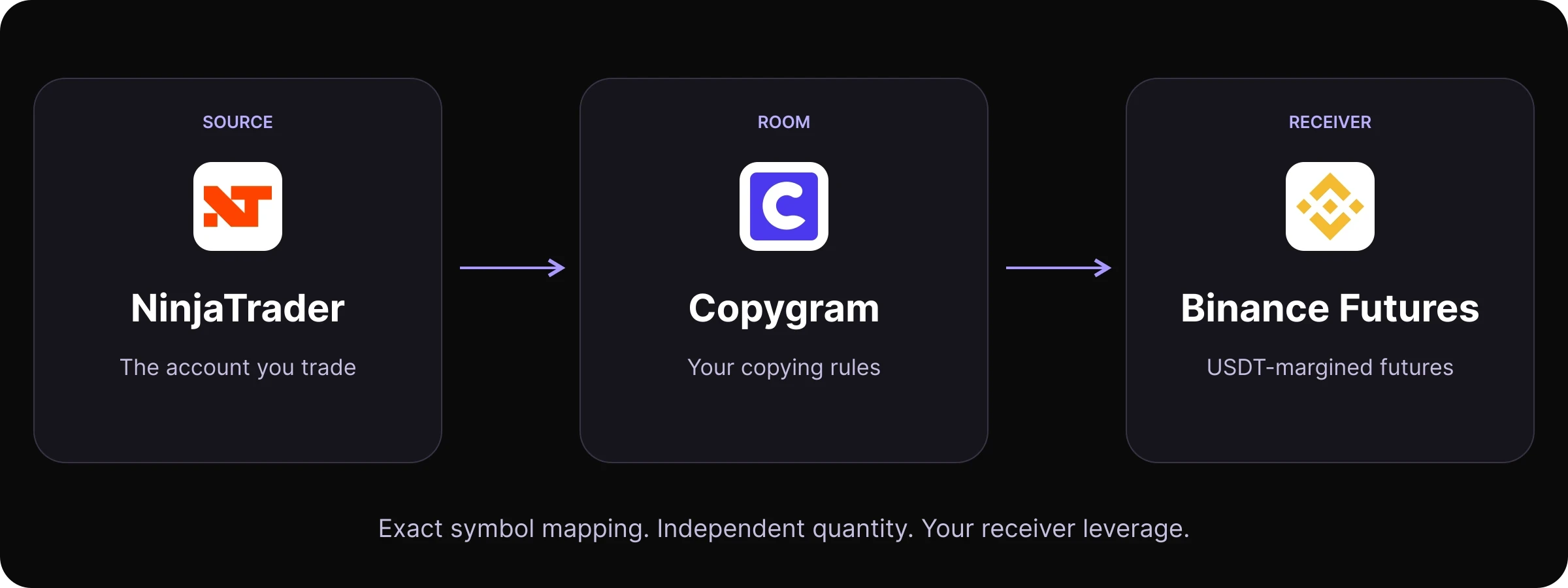
Yes. Copygram connects NinjaTrader as the source and Binance Futures as the receiver. A copying room applies your symbol mapping, destination quantity, leverage and trade-management rules to source account activity. Each account keeps its own balance and positions.
NinjaTrader is your source
Choose the account you trade. Its account activity supplies the trades for your copying room.
Copygram connects the workflow
The room links one source to your selected receivers and applies each account’s copying rules.
Binance Futures is your receiver
Connect a USDT-margined Binance Futures account with an API key and secret. Its receiver settings define the destination orders.
BUILT FOR YOUR WORKFLOW
One NinjaTrader workflow. Your Binance Futures settings.
Keep your trading decisions in NinjaTrader while controlling the market, quantity, leverage and trade updates for each receiver.
Reduce repeated order entry
Place the trade on your NinjaTrader source. Copygram routes its activity to the Binance Futures receiver in your room.
Map the exact market
Connect your dated NinjaTrader futures contract to the intended USDT-margined Binance Futures instrument.
Separate quantity and leverage
Set the receiver’s order quantity and leverage independently. Give each destination its own configuration.
Add independent receivers
Connect one source to multiple receiving accounts. Configure symbols, sizing and trade management for each receiver.
QUICK START
How to copy NinjaTrader trades to Binance Futures
Connect both accounts, create a room and configure the Binance Futures receiver in five steps.
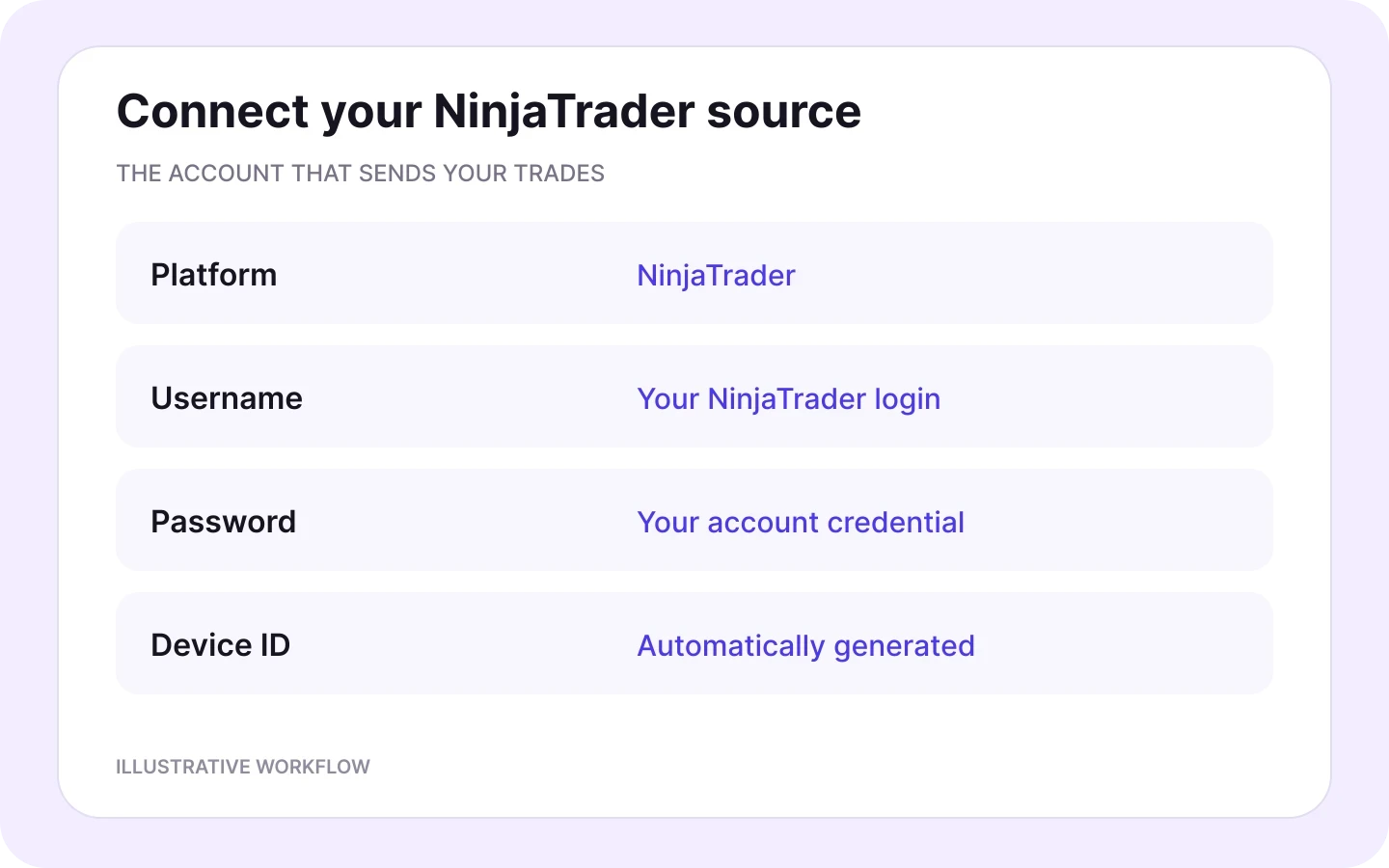
In Copygram, add a trading account and select NinjaTrader. Enter your NinjaTrader username and password; the Device ID is generated automatically. The documented connection uses the official Tradovate API. Select the account you want to copy from.
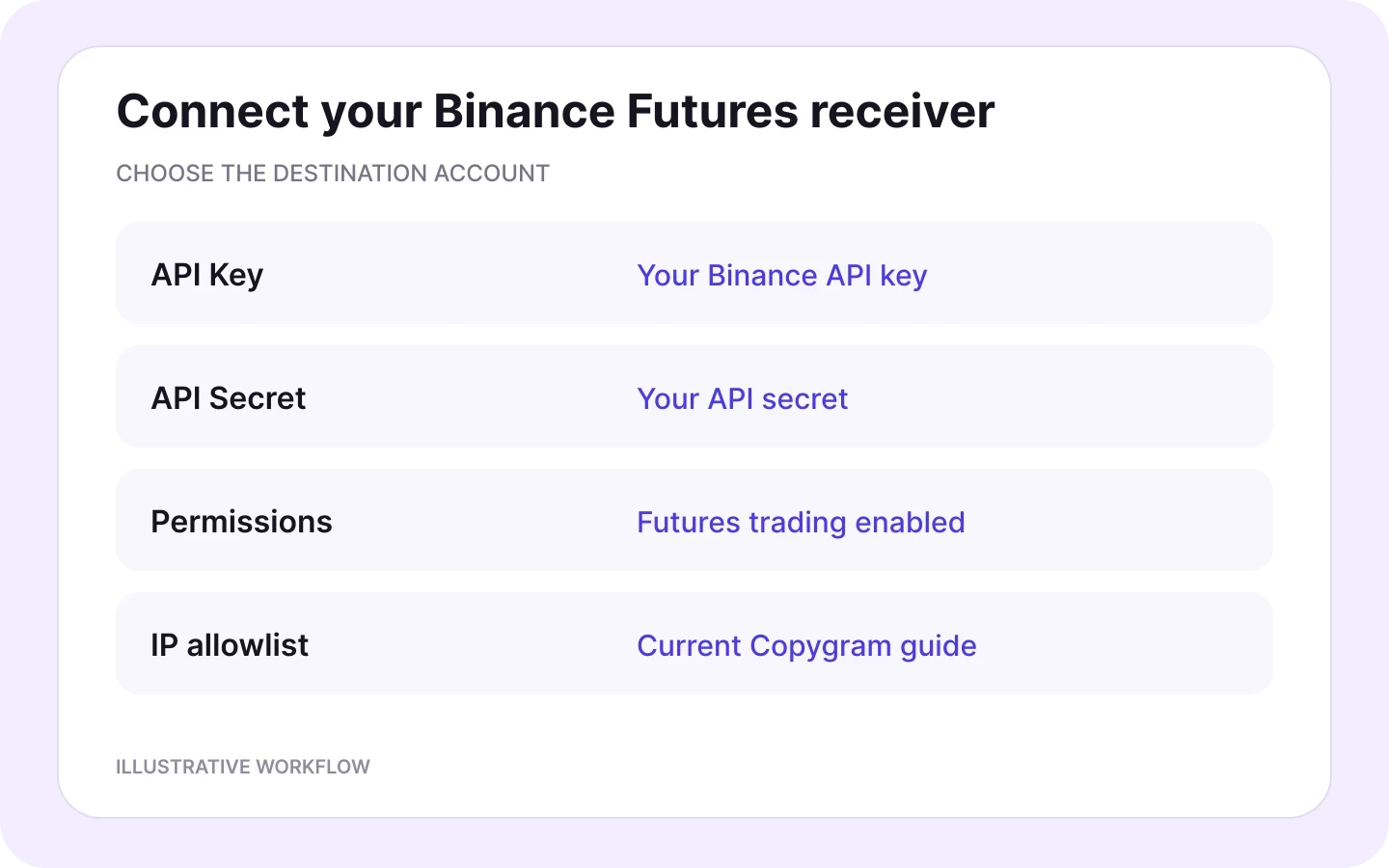
Add Binance Futures with your API Key and API Secret. Enable Futures trading permissions and apply the current Copygram IP allowlist from the connection guide. Keep withdrawal permissions disabled. This connection uses USDT-margined futures.
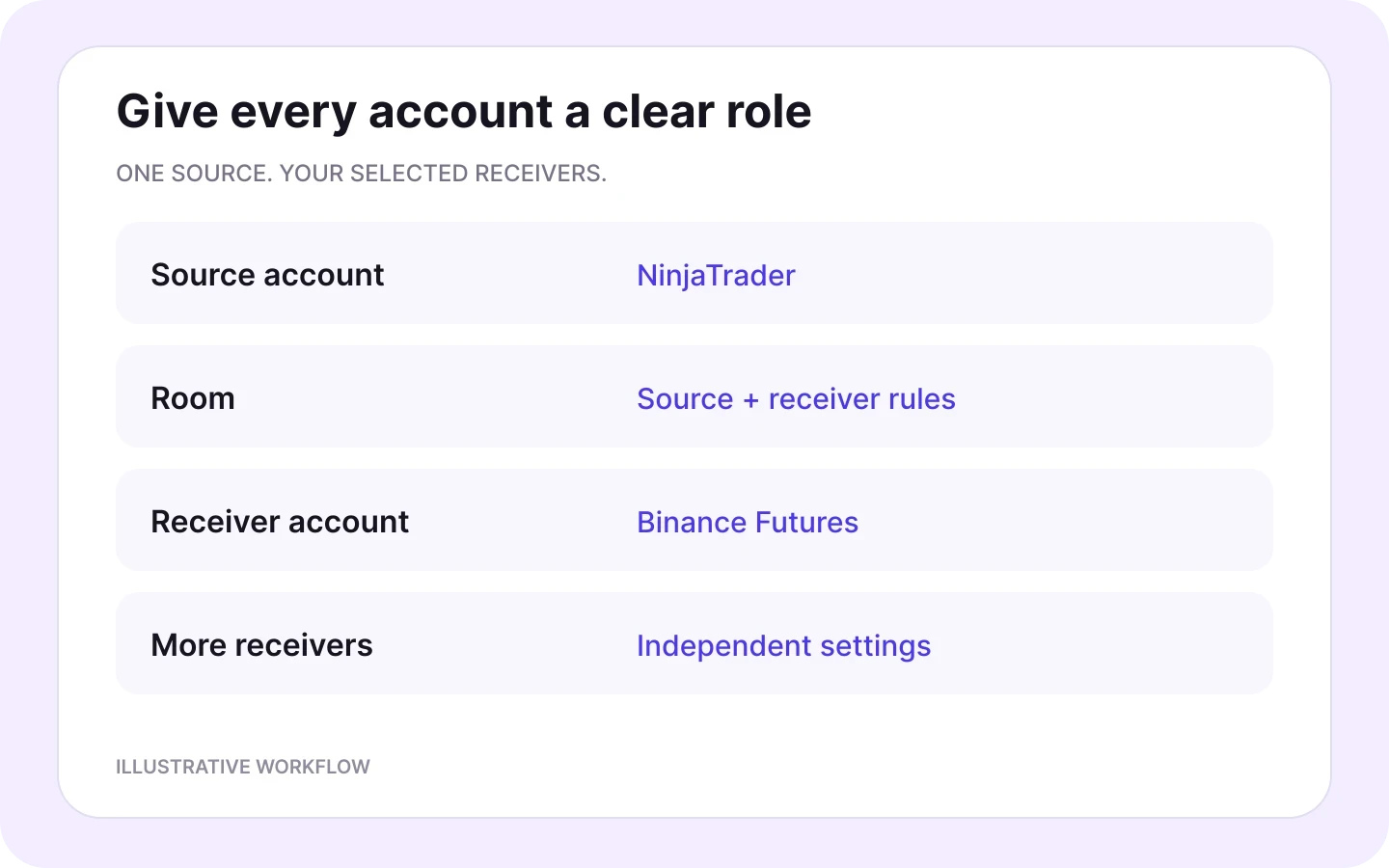
Choose NinjaTrader as the room’s source and Binance Futures as a receiver. Name the room and accounts clearly. A room connects one source to one or more receivers, each with independent settings.
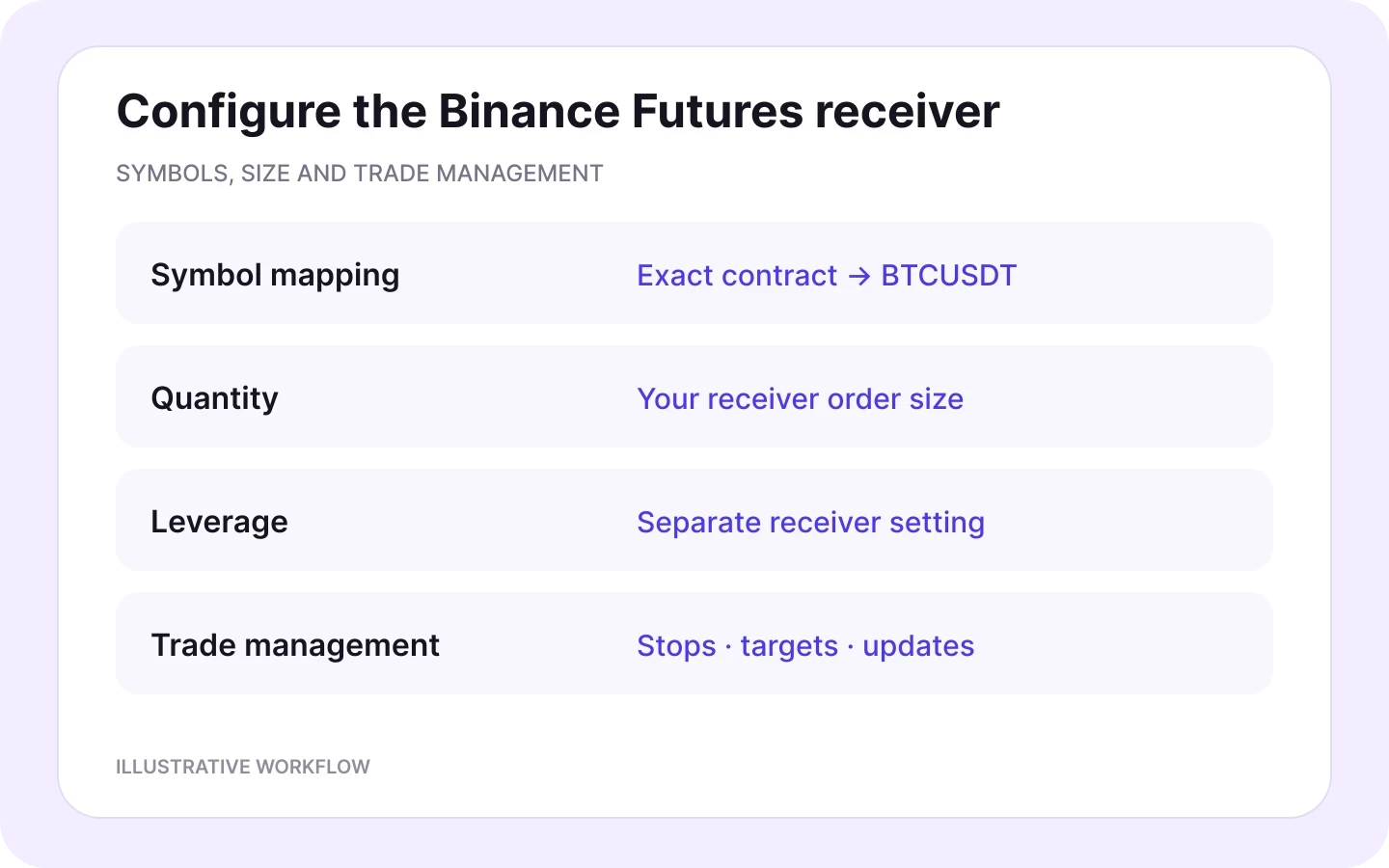
Map the exact source contract to the intended Binance Futures symbol. Configure receiver quantity, symbol-specific exceptions and leverage, then set stops, targets, close and modification controls, filters and trading schedules.
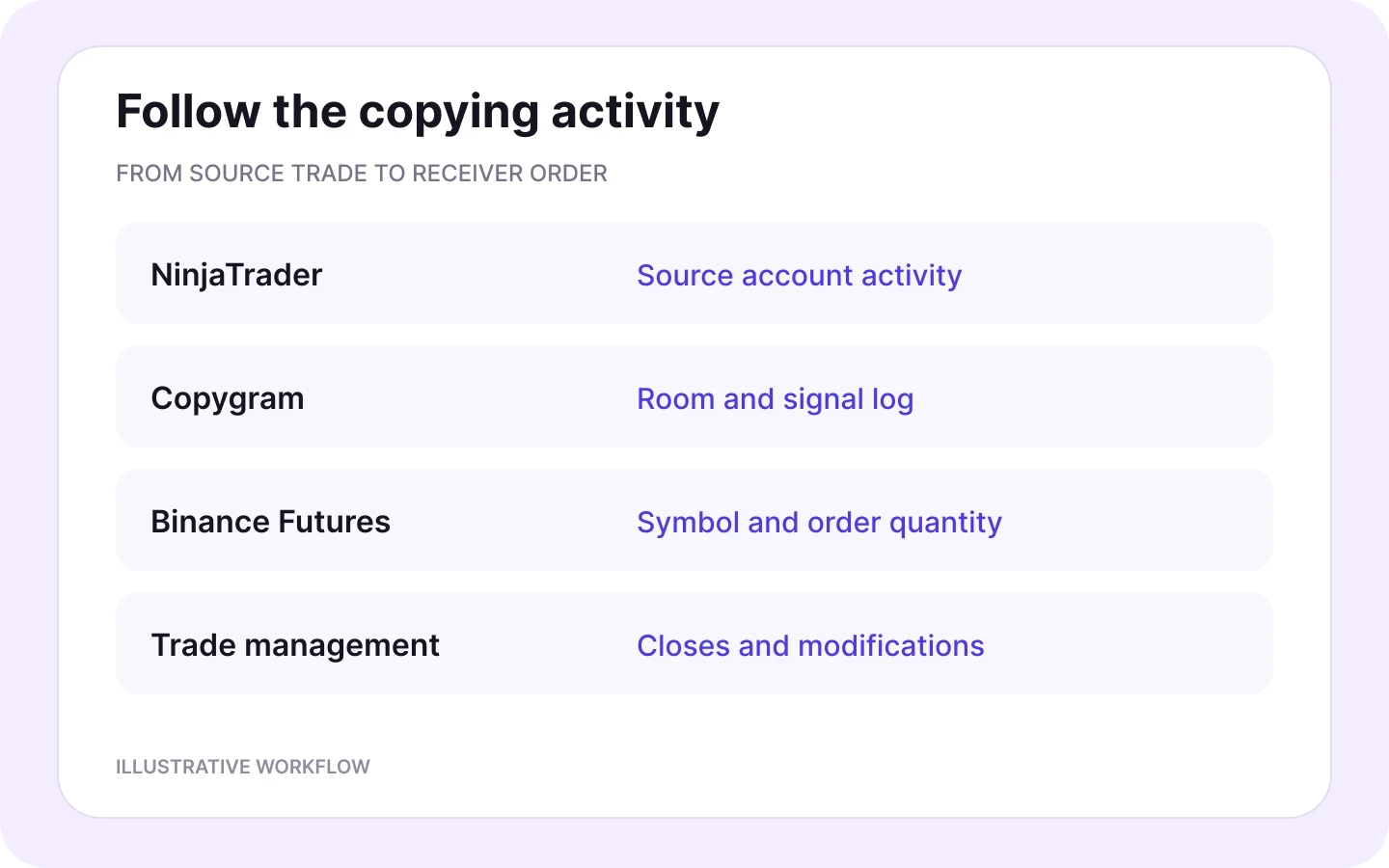
Activate the room to start copying. Follow your NinjaTrader source activity, Copygram signal log and Binance Futures orders. View the receiving symbol, quantity and trade updates together as you manage the workflow.
BINANCE FUTURES CONNECTION
Connect Binance Futures with the right API settings
The API key identifies the connection. Futures permissions and the Copygram IP allowlist define its trading access.
API key and secret
Create the key in Binance API Management. Add the API Key and API Secret to the Binance Futures connection in Copygram.
Futures trading permissions
Enable Futures trading for the API key. Keep withdrawal permissions disabled for this order-copying connection.
Current Copygram IP allowlist
Use the IP address shown in the current Copygram connection guide when configuring your Binance API restrictions.
Keep the API secret private. The linked Copygram connection guide is the reference for the current IP allowlist and platform setup details.
FUTURES SYMBOL MAPPING
Map Micro Bitcoin futures to BTCUSDT Futures
Map the exact dated Micro Bitcoin contract on NinjaTrader to BTCUSDT on your USDT-margined Binance Futures receiver. Keep the source expiry and destination market explicit.
Source contract
Use the full Micro Bitcoin (MBT) contract identifier and expiry reported by your NinjaTrader connection.
Destination instrument
Select BTCUSDT on the USDT-margined Binance Futures receiver. Use the exact instrument identifier from that connection.
Receiver configuration
Configure the destination quantity independently from the source contract count. Set leverage and protective orders in the receiver settings.
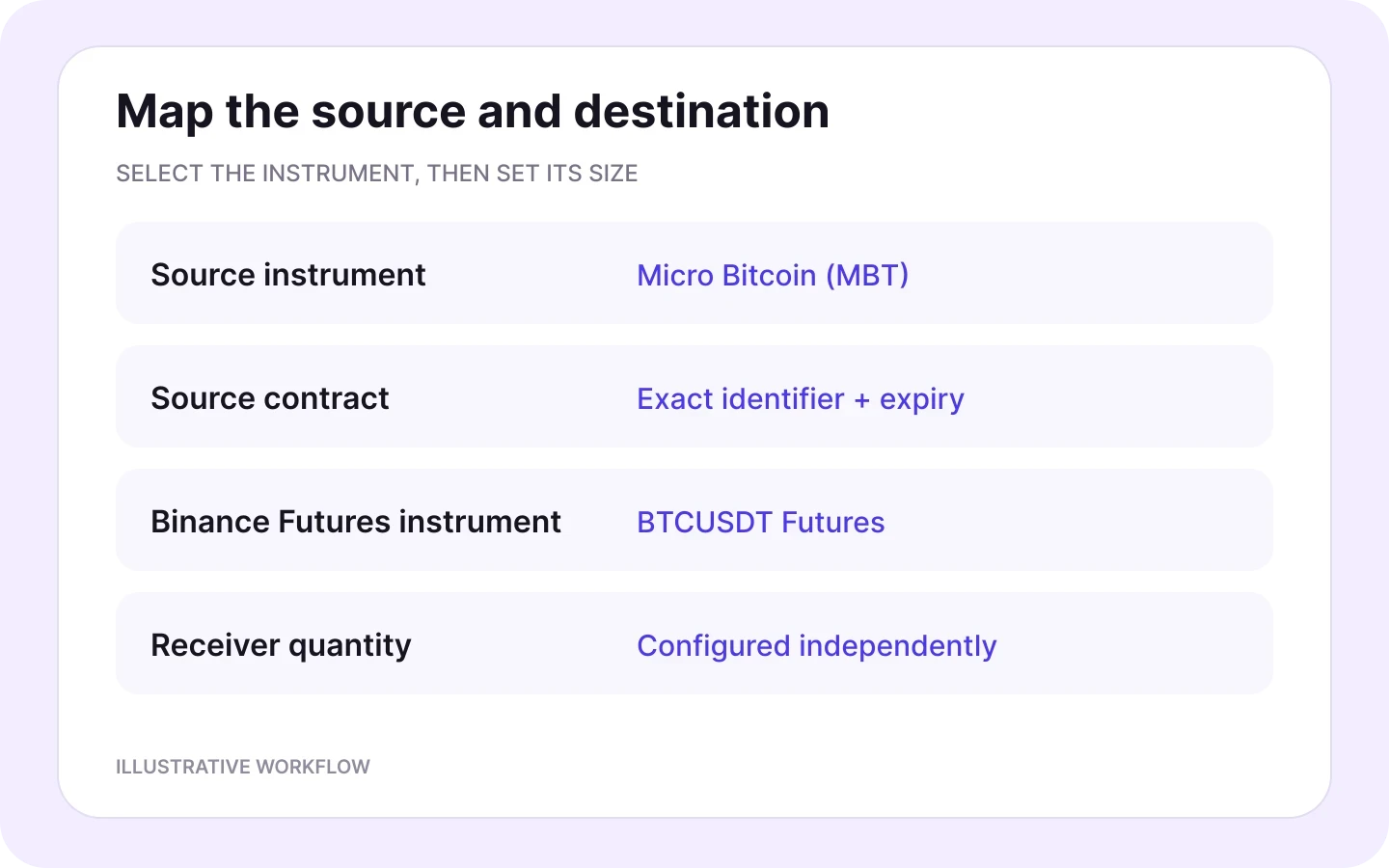
Symbol mapping chooses the market; receiver sizing defines the order quantity. Update the source identifier when you move to a new NinjaTrader contract expiry, keeping the intended Binance Futures destination selected.
QUANTITY & LEVERAGE
Separate source contracts, receiver quantity and leverage
The source contract has its own specification. Your Binance Futures receiver has its own order units and leverage setting.
NinjaTrader source contract
1 MBT = 0.1 bitcoin
CME defines one Micro Bitcoin futures contract as one-tenth of a bitcoin. This describes the source contract’s size; it is not an automatic receiver quantity rule.
Binance Futures receiver
Quantity + leverage
Set destination quantity using the instrument’s order units, quantity step and minimum order requirements. Configure leverage separately: quantity and price define position notional, while leverage affects margin requirements.
Mapping does not create a fixed one-to-one quantity conversion. Set receiver quantity through money management and Symbol Lot Exceptions; a symbol-specific exception overrides the default. Leverage remains a separate control and does not replace the quantity setting.
RECEIVER CONTROLS
Control how Binance Futures follows NinjaTrader
Set the instruments, quantity, leverage and trade management for each receiving account.
Receiver quantity
Set destination sizing through money management and symbol exceptions. Symbol Lot Exceptions take priority over the default.
Receiver leverage
Configure Binance Futures leverage separately from quantity. Leave the field empty to keep the broker default described in the settings guide.
Mapping & filters
Match the exact source contract to its destination symbol and choose which instruments the receiver follows.
Stops & targets
Configure stop-loss and take-profit behavior using the Binance Futures instrument’s own price basis.
Copy Close Orders
Choose whether the receiver follows source closing actions or uses your own exit management.
Copy Modif Orders
Control whether the receiver follows source trade modifications.
Trading schedules
Set active windows and the schedule timezone for your NinjaTrader source and Binance Futures workflow.
Signal logs
Follow recorded actions and status alongside your Binance Futures orders and positions.
CLEAR ACCOUNT ACTIVITY
Follow the trade from NinjaTrader to Binance Futures
Keep the source activity, copying room and receiving account easy to identify throughout your workflow.
NinjaTrader source
View the account, futures contract and activity that generated the trade.
Copygram signal log
Follow the recorded action and status for your Binance Futures receiver.
Binance Futures orders
View the destination symbol, direction, order quantity and trade updates in the receiving account.
Using a NinjaScript strategy? Keep its required NinjaTrader environment running to generate source trades. Copygram routes the resulting account activity to your configured Binance Futures receiver.


SUPPORTED PLATFORMS
Connect NinjaTrader to Every Platform
Copy NinjaTrader trades to your connected accounts. Give every receiving platform its own symbols, position sizing and trade-management settings.
NinjaTrader to NinjaTrader
Copy trades between NinjaTrader accounts. Connect one source to multiple receivers with independent contract sizing and settings.
NinjaTrader to NinjaTrader


NinjaTrader to Tradovate
Copy NinjaTrader trades to separate Tradovate accounts with exact futures contract mapping and independent receiver quantities.
NinjaTrader to Tradovate

NinjaTrader to MT5 & MT4
Copy NinjaTrader trades to hosted MT5 and MT4 accounts with independent symbols and lot sizing.
NinjaTrader to MetaTrader

NinjaTrader to TradeLocker
Copy NinjaTrader trades to a TradeLocker receiver. Select your account, map instruments and configure independent lot sizes.
NinjaTrader to TradeLocker

NinjaTrader to OANDA
Copy NinjaTrader trades to OANDA Live and Practice accounts. Configure symbol mapping, receiver quantity and trade-management settings.
NinjaTrader to OANDA

NinjaTrader to Binance Futures
Copy NinjaTrader trades to Binance Futures with exact symbol mapping, independent receiver quantity and leverage.
NinjaTrader to Binance Futures

NinjaTrader to MatchTrader
Copy NinjaTrader trades to MatchTrader demo and live accounts. Select your broker account, map instruments and set receiver lot sizing.
NinjaTrader to MatchTrader

NinjaTrader to DXtrade
Copy NinjaTrader trades to DXtrade. Connect your broker domain and account, then configure symbol mapping and receiver lots.
NinjaTrader to DXtrade
Explore all NinjaTrader integrations
NinjaTrader Hub
FAQ
NinjaTrader to Binance Futures FAQs
Answers about API connections, Micro Bitcoin mapping, receiver quantity, leverage and trade-management settings.
Can I copy NinjaTrader trades to Binance Futures?
Yes. Copygram connects NinjaTrader as the source and Binance Futures as the receiver. Add both accounts, create a room and configure symbol mapping, receiver quantity, leverage and trade-management settings. Activate the room to start copying.
What is a NinjaTrader to Binance Futures trade copier?
It uses trades from a connected NinjaTrader account as instructions for a Binance Futures receiver. Copygram applies the receiver’s symbol mapping, quantity, leverage and trade-management rules in a room. Each account keeps its own balance and positions; copying does not transfer funds between them.
How do I connect NinjaTrader as the source?
Select NinjaTrader when adding a trading account in Copygram. Enter your NinjaTrader username and password; the Device ID is generated automatically. The documented connection uses the official Tradovate API. Choose the account whose trades you want to copy.
Which Binance Futures credentials and permissions do I need?
Use the API Key and API Secret from Binance API Management. Enable Futures trading permissions and apply the current IP allowlist shown in the Copygram connection guide. Keep withdrawal permissions disabled and store the API secret securely.
Which Binance Futures market does Copygram connect to?
The documented Copygram connection supports USDT-margined Binance Futures. Select the destination instrument from that connection and configure its receiver quantity, leverage and trade-management settings.
Where do I find the Copygram IP address for Binance?
Use the IP allowlist shown in the current Binance Futures platform guide in Copygram’s documentation. Add that address to the API key’s IP restrictions in Binance API Management, alongside the required Futures trading permissions.
Can I map NinjaTrader Micro Bitcoin futures to BTCUSDT?
Yes. Map the exact NinjaTrader MBT contract identifier, including its expiry, to BTCUSDT on the USDT-margined Binance Futures receiver. Configure destination quantity separately and update the source mapping when you change contract months.
How do source contracts relate to Binance Futures quantity?
One CME Micro Bitcoin futures contract represents 0.1 bitcoin. Binance Futures order quantity is configured separately through Copygram receiver sizing and Symbol Lot Exceptions. Mapping selects the instrument; it does not create a fixed one-to-one quantity conversion. Symbol-specific exceptions override default money management.
How does leverage work on the Binance Futures receiver?
Configure leverage separately from destination quantity. Quantity and price determine position notional, while leverage affects the margin required for that position. Leverage does not replace the receiver quantity setting. The Copygram settings guide describes leaving the leverage field empty to use the broker default.
Can one NinjaTrader account copy to multiple Binance Futures accounts?
Yes. A Copygram room connects one source to one or more receivers. Add the Binance Futures accounts and set mapping, quantity, leverage and trade-management rules for each receiver. Count the source and receivers when choosing your plan’s connected-account allowance.
How do I manage stops, targets, closes and modifications?
Configure stop-loss and take-profit behavior using the Binance Futures instrument’s price basis. Use Copy Close Orders and Copy Modif Orders to choose the source closing actions and updates that each receiver follows. Track recorded activity in Copygram logs and your Binance Futures account.
Can I copy trades generated by a NinjaScript strategy?
Yes. Copygram routes account trades from the connected NinjaTrader source, including strategy-generated trades, to the Binance Futures receiver. Keep the NinjaScript strategy running in its required NinjaTrader environment to generate the source activity.
What should I update when my NinjaTrader contract changes expiry?
Update the source mapping to the exact NinjaTrader contract and expiry you are now trading. Keep the intended Binance Futures destination selected, with the receiver quantity, leverage and trade-management settings for that account.
Can I choose which symbols and trading hours Binance Futures follows?
Yes. Symbol filters define which instruments the receiver follows, and trading schedules define its active windows. Configure the timezone and market hours for your workflow. Each Binance Futures receiver has its own symbol rules and schedule.