Funded Trading Plus Review: Copy Trading and Account Rules
Prop Firms
Check Funded Trading Plus copy-trading rules, account limits and drawdown differences. Learn what to verify before connecting MT5 or MatchTrader to Copygram.
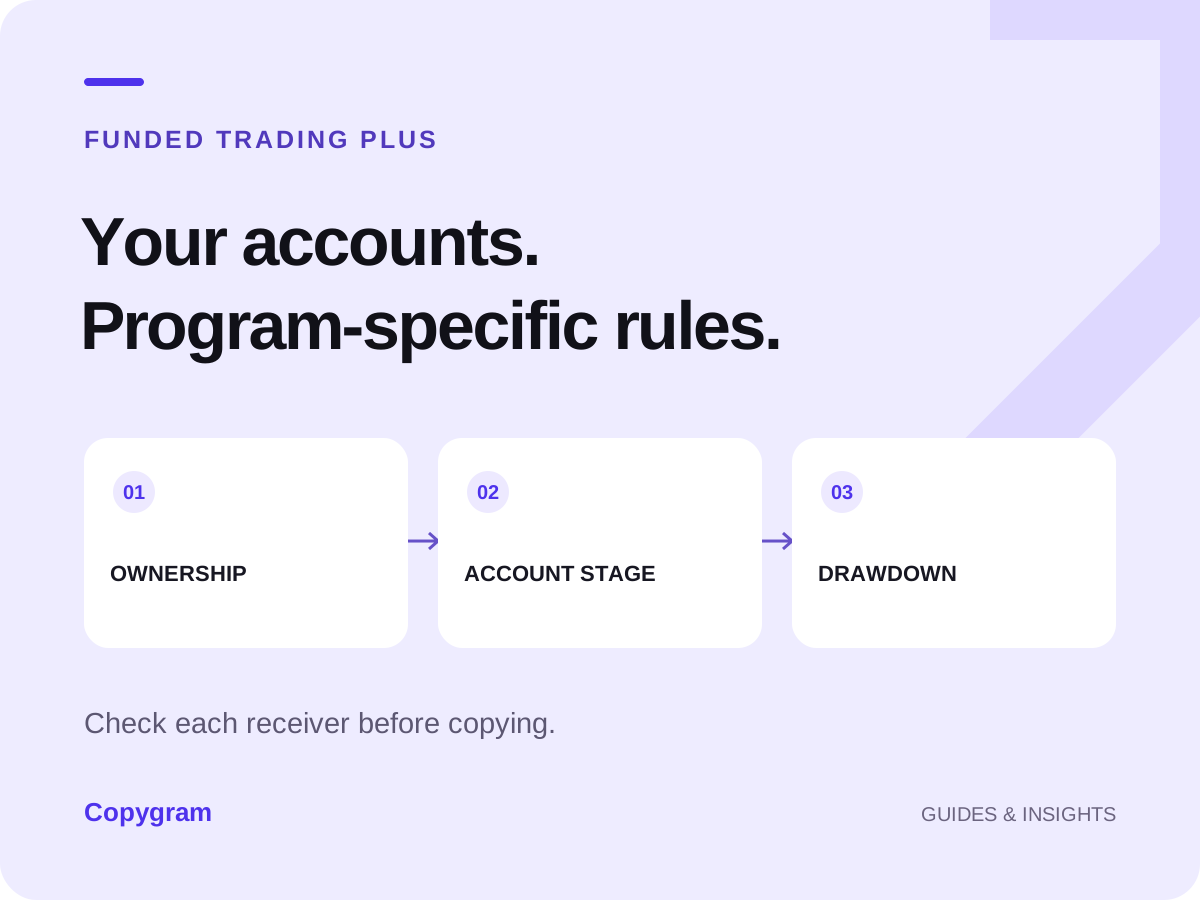
Funded Trading Plus allows copying between accounts that belong to you. Copying another trader’s positions or letting another person copy yours is prohibited. For a Copygram setup, start with that ownership rule, then check the exact program, account stage and trading platform. Official copy-trading policy.
This review was checked on October 1, 2026. Copygram publishes this guide to help traders evaluate a connection; it is based on FT+ documentation, not a personally completed challenge or independently verified payout. FT+ provides simulated trading accounts, as explained in its program terms.
What copying is allowed at Funded Trading Plus?
The own-account rule concerns who makes the trading decisions as well as which accounts are connected. Copying a third-party Telegram signal into a personal source account does not turn someone else’s strategy into your own. FT+ also says that matching positions across different traders may be flagged even when entry and exit times differ. Copying restrictions.
FT+ permits EAs, algorithms and bots subject to its restrictions, including prohibitions on arbitrage, grid trading and tick scalping. Its EA article also contains restrictions on copying and hedging across FT+ accounts. If your proposed method uses an EA, ask FT+ to confirm that exact arrangement alongside its own-account copying policy. EA and bot guidance.
Keep a simple connection record: source account, receivers, ownership, platform and how orders originate. That record is more useful than relying on a general statement that a firm “allows automation.” Cross-account hedging remains prohibited under the program terms.
Account limits still apply when copying is permitted
The AUM policy separates evaluation accounts from simulated-live allocation. It lists up to two 1-Step Express simulated-live accounts within a $200,000 program ceiling, while 2-Step Classic permits one simulated-live account and cannot be held alongside an active 1-Step Express simulated-live account. Instant accounts have no hard account-count limit in that policy. Legacy programs have separate entries. Allocation and merging rules.
Adding another receiver in a copier does not increase FT+ allocation. Check the current allowance before buying another evaluation, and again before connecting a replacement or newly funded account.
Drawdown depends on the program
1-Step Express: balance-based trailing maximum
The Express guide lists a 10% profit target, 4% daily drawdown and 6% relative maximum drawdown. The maximum threshold follows the balance high-water mark until it reaches the initial balance, where it stops. Daily drawdown uses the previous trading day’s closed balance. Weekend holding is permitted. The program has no completion deadline, but requires account activity within each 30-day period. Express program rules.
2-Step Classic: static maximum and additional checks
Classic lists 7% targets in both phases, 8% static maximum drawdown and 4% daily drawdown. It also has a consistency requirement of 35% during evaluation and 50% on the simulated-live account. Its separate 3% Symbol Loss Limit combines simultaneous positions on one instrument and is a hard-breach rule. Classic program rules.
For a copier user, the practical distinction is aggregate exposure. Three entries on gold still share the symbol-level loss allowance; treating each ticket as a separate risk budget can underestimate the combined exposure.
Instant: trailing drawdown and Friday closure
Instant has 6% relative maximum drawdown and 6% daily drawdown. The daily calculation uses the higher prior-day balance or equity, while the maximum threshold trails the balance high-water mark until it locks at the initial balance. The guide requires positions to close by its specified Friday cutoff. Read the current timing and payout conditions before running an unattended receiver. Instant program rules.
Activation Accounts: recheck the funded-stage rules
The Activation challenge has a 2% target, 4% balance-based daily loss limit and 6% static maximum drawdown. Activation challenge rules.
After funding, the daily limit becomes 3%, the 6% maximum drawdown trails equity until locking at the starting balance, and a 25% consistency condition applies at payout. This is a concrete reason to review receiver settings after passing instead of carrying them over unchanged. Activation funded-account rules.
Connecting an eligible account to Copygram
FT+ publishes current instructions for MT5 login and MatchTrader. Use the platform and provider issued for your account. A platform name in an older review is not confirmation that it is currently available for your purchase.
Copygram supports MT5 as a source or receiver and MatchTrader as a receiver. Review the MetaTrader copier or MetaTrader-to-MatchTrader route, then follow the connection documentation.
Confirm the account owner, program, stage, platform and server before connecting.
Choose a source you control and add only eligible receivers.
Check symbol mapping, contract specifications, minimum volume and receiver sizing.
Verify entry, stop modification and close behavior on an appropriate demo or small test before expanding.
Reconcile actual positions when an order is rejected or only partly filled.
Copygram’s position-sizing controls do not provide a verified FT+ daily-loss, symbol-loss or trailing-drawdown lockout. Use the lot-sizing guide to understand the settings, and continue monitoring each account’s remaining loss allowance.
Once permissions and the connection are confirmed, compare the current Copygram plans. There is no free trial. Copygram can reduce repeated order entry across eligible accounts; it does not guarantee passing a challenge or receiving a payout.

Julian Vance
Julian Vance is an independent writer and quantitative strategist. He writes about trading automation and account-management workflows for Copygram.
Join our newsletter list
Sign up to get the most recent blog articles in your email every week.


More Articles